Holding On to the Herbs That Hold Us
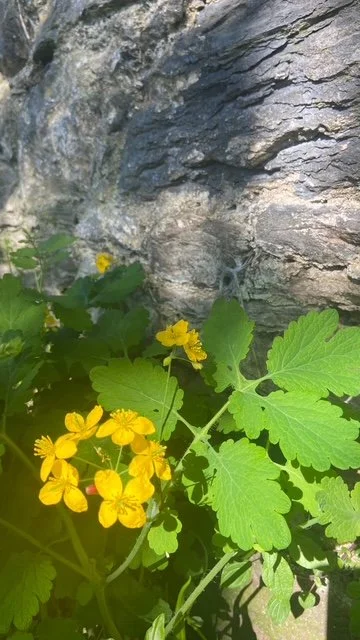
Wild Chelidonium majus, photo by Me
Greater celandine, Chelidonium majus, is a plant that has slipped quietly into the background of modern herbal practice. Yet it once held a firm and respected place in the European materia medica. It grows in the half‑wild edges of gardens and stone walls with yellow flowers bright against the green. Its orange sap hints at a potency that herbalists have understood for centuries. Today, it sits on the UK’s Schedule 20 list. A reminder that this is not a gentle kitchen herb but a plant with real physiological force. One that can only be prescribed by qualified medical herbalists.
The story of greater celandine is, in many ways, the story of herbal medicine itself, a tension between tradition and modernity. Between the complexity of whole plants and the narrow focus of contemporary evidence. Between the richness of diversity and the slow drift toward uniformity.
Traditionally, greater celandine was valued for a wide range of actions. Herbalists described it as a stimulant, alterative, diuretic, diaphoretic, purgative and vulnerary. These words may sound old‑fashioned, but they speak of a time when practitioners observed the body as a dynamic, interconnected system. A stimulant was something that encouraged movement where stagnation had taken hold. An alterative supported the body’s ability to shift, clear and rebalance. And a vulnerary soothed and repaired. These actions were part of a broader understanding of how the body responded to stress, illness and imbalance.
Modern research has added another layer to this picture. Greater celandine contains, a group of isoquinoline alkaloids that are thought to be responsible for antispasmodic and cholagogue effects. These compounds can be profoundly helpful when used with skill, but they also require respect. Inappropriate use can place strain on the liver. Which is why the herb is now restricted to practitioners trained to assess when it is appropriate, how it should be dosed and who it is safe for. Schedule 20 status is not a punishment, it is an acknowledgement of potency. It recognises that some plants sit closer to the boundary between medicine and harm. That these plants require the depth of training that medical herbalists hold.
But there is a risk here. When a herb becomes restricted, it can slowly slip out of common use. When it slips out of use, it slips out of memory. And when it slips out of memory, it becomes easier for regulators to tighten restrictions further. This is how a living tradition becomes a historical footnote.
If we rely only on herbs with the largest bodies of modern evidence, we narrow our practice to a small handful of plants. The same few that appear in every study, every trial, every commercial product. This mirrors what has happened in our food systems. Once, human diets contained hundreds of cultivated plants. Now, the majority of global calories come from just four or five crops. Diversity has been replaced by convenience, resilience by uniformity. And with that loss of diversity comes fragility.
The same is true in herbal medicine, if we allow our materia medica to shrink. When our work narrows to the safest and most commercially familiar herbs, the rich diversity that once shaped traditional practice starts to slip away. These are the plants that work in the subtle spaces, those that act on the edges of systems. The ones that require nuance, that don’t fit neatly into modern research models but have supported human health for centuries.
Greater celandine is one of those plants. It is strong, complex and deeply rooted in tradition. It asks us to hold both the scientific and the historical, the measurable and the experiential. It reminds us that herbal medicine is not only about gentle teas and familiar remedies. But also about potent plants that require training, respect and continuity of use.
If we want to keep these herbs in our hands, we must keep them in our practice. We must continue to study them, to understand them, to use them wisely and professionally. Because once a herb is forgotten, it is very hard to bring it back. And the loss of one plant is never just the loss of one plant. It is the loss of a thread in the wider tapestry of herbal medicine. This practice depends on diversity, depth and the willingness to honour both old knowledge and new understanding. Greater celandine stands as a reminder of what we risk losing and of why it matters that we don’t.